
Practical, tailored leadership development aligned to real organizational needs.
Leadership development is often treated as a training activity rather than a performance system. Organizations invest heavily in courses and workshops, yet still struggle with unclear priorities, inconsistent leadership behavior, and uneven execution. At Fusion Coaching & Consulting Group, leadership development is approached differently. It is treated as a disciplined process that connects strategy, leadership expectations, organizational systems, and execution.
While training can be valuable, leadership performance rarely improves unless several deeper conditions are present within the organization itself. Leaders must understand the strategic direction of the organization, see leadership as part of their identity and responsibility, operate within clearly defined expectations, and work within systems that reinforce — rather than contradict — the behaviors the organization expects. When these conditions are present, leaders are far more likely to translate intention into disciplined execution.
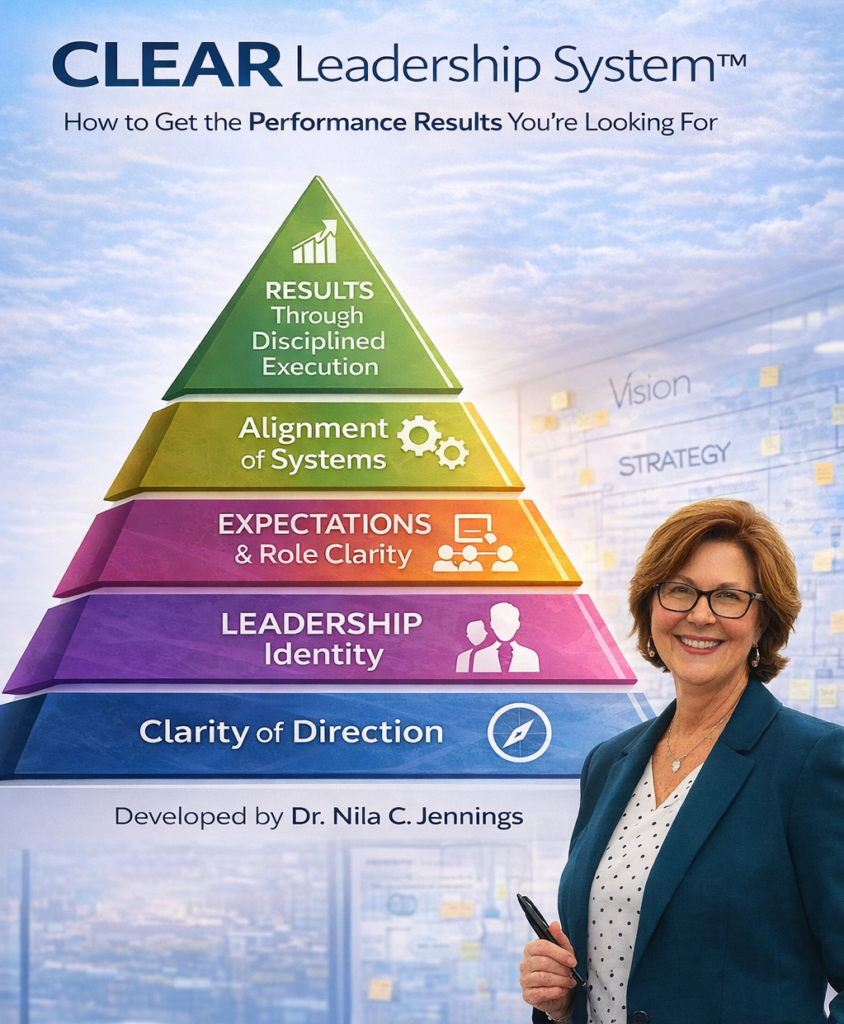
Fusion’s leadership development work is guided by the CLEAR Leadership System™, a practical framework developed from leadership research and years of consulting experience working with organizations that operate in complex, high-accountability environments.
The CLEAR framework brings these conditions together into a coherent approach to leadership development.
Clarity of Direction
Effective leadership begins with clarity. Leaders must understand the organization’s strategic priorities and how their role contributes to those priorities. Without this shared understanding, even highly capable leaders can unintentionally pull the organization in different directions.
Leadership Identity
Leadership effectiveness also depends on how individuals see themselves. When people begin to view leadership not merely as a position but as part of their professional identity, they are more likely to assume responsibility for results, develop others, and make decisions that advance the organization’s goals.
Expectations and Role Clarity
Leaders perform best when expectations are clear. Clearly defined responsibilities, decision authority, and accountability boundaries reduce confusion, minimize conflict, and allow leaders to focus their energy on guiding the work of their teams.
Alignment of Systems
Leadership behavior is strongly influenced by the systems that surround it. Organizational structures, incentives, processes, and performance measures must reinforce the behaviors leaders are expected to demonstrate. When these systems are aligned, leadership development efforts gain traction and credibility.
Results Through Disciplined Execution
Ultimately, leadership is measured by results. Clarity of direction, leadership identity, well-defined expectations, and aligned systems create the conditions for leaders to translate strategy into action. Disciplined execution means consistently turning priorities into decisions, decisions into coordinated action, and action into measurable outcomes. Leaders who operate within this discipline ensure that strategy is not simply discussed, but carried forward through the daily work of the organization.
Programs designed for technical and operational leaders who must deliver results through others. Development focuses on judgment, communication, delegation, and decision-making habits that translate directly to day-to-day performance.
Leadership development for supervisors, managers, and directors operating in environments shaped by public accountability, policy constraints, and community expectations. Training builds consistency, clarity, and leadership confidence across roles and departments.
Structured development for high-potential employees and newly promoted leaders who are strong individual contributors but new to leading people. Programs build role clarity, sound authority practices, and the shift from doing work to leading work.
Leadership development for engineers, scientists, and technical professionals working in environments where expertise, safety, and precision define credibility. Training supports the identity shift from expert to leader — helping technical leaders retain professional confidence while developing the judgment, authority, and relational skills required to lead others.
Leadership development work is typically integrated with broader consulting and organization development efforts. Depending on the organization’s needs, engagements may include focused leadership workshops, multi-session development programs, leadership team facilitation, or targeted consulting to address specific performance challenges. The goal is not simply to deliver training, but to strengthen the leadership conditions that support clarity, accountability, and disciplined execution..
Organizations often begin this conversation when leadership expectations become unclear, execution slows, or performance varies across teams. If your organization is exploring how leadership capability connects to performance, we would welcome the opportunity to talk.